


Ensure your garage is safe with our top tips to prevent break-ins. Learn how to secure your garage door effectively and protect your belongings today!
Reasons to Love Your Garage Doors
- Your Garage door adds good value to your house
- Your garage door protects the things you need
- You probably go through the garage all the time
- Neglected Garage doors can destroy your needs
- Your Garage doors might hide dangers if you neglect the garage
- A garage can be a lot more fun place than you think
Best Smart Garage Door Security Cameras: Comprehensive Reviews and Buying Guide for 2025
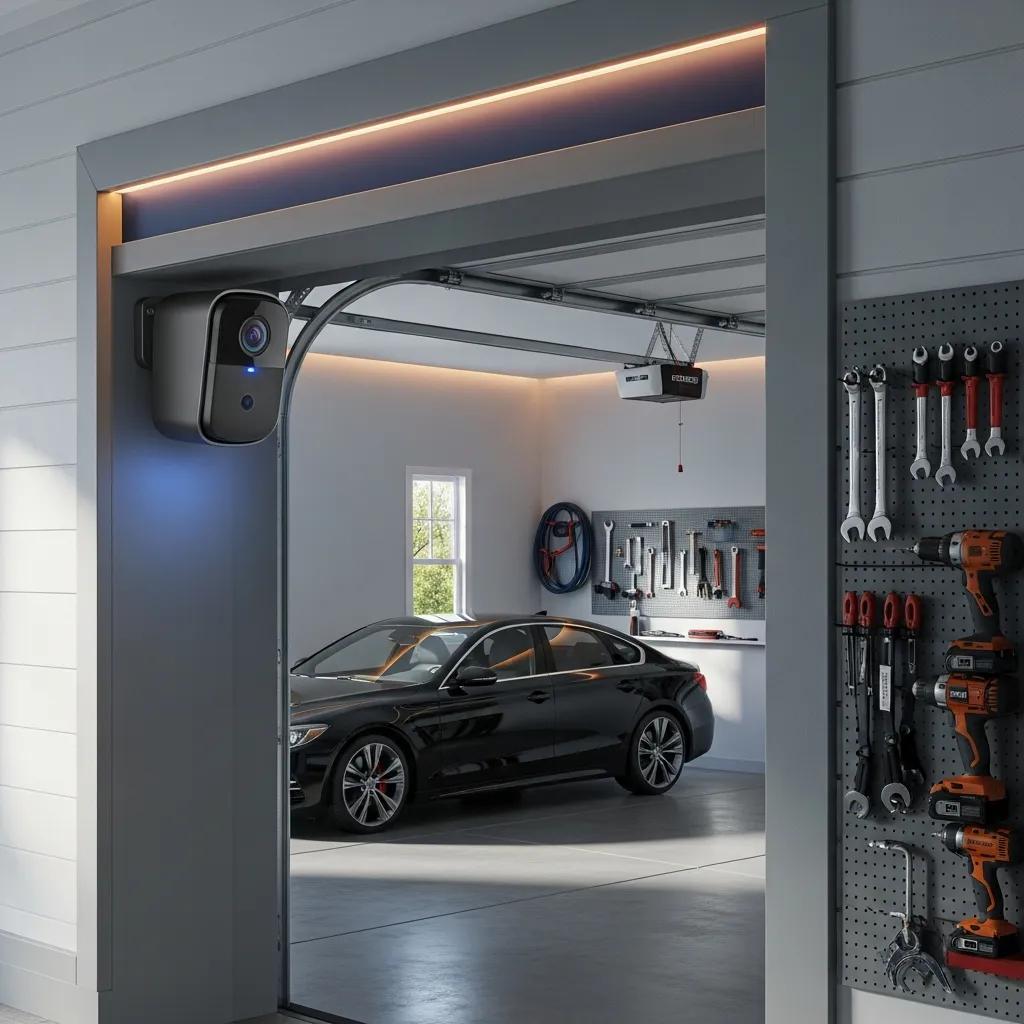
Garages are a high-value, high-risk point around the home where tools, vehicles, and packages concentrate vulnerability, and a smart garage camera provides targeted surveillance that prevents theft, documents incidents, and links to automation for real-time control. This guide explains what a smart garage camera is, why garages require specialized coverage compared with generic outdoor cameras, and how features such as AI detection, resolution choices (1080p, 2K, 4K), and storage options influence performance. You will learn how to evaluate top brands and system types, practical installation and Wi-Fi optimization techniques for attached and detached garages, and privacy and legal considerations relevant in late 2025. The article includes model- and brand-level comparison tables, clear feature tradeoff charts, actionable step-by-step installation checklists, and integration guidance for Alexa, Google Assistant, and HomeKit. Read on to get a concise buying framework, side-by-side comparisons, and hands-on setup best practices so you can choose and deploy the best smart garage camera for your needs.
Why Choose Smart Garage Door Security Cameras for Your Home?
A smart garage door security camera is a networked video device focused on monitoring garage interiors and entries, using real-time alerts and automation to reduce risk and provide usable evidence. These systems combine sensors, video streams, and smart-home integrations to deter theft, verify deliveries, and allow remote control of garage door openers, delivering immediate situational awareness when a door opens or motion is detected. Garages present distinct challenges—enclosed spaces, variable lighting, stored valuables, and detached locations—so targeted cameras with suitable night vision and AI filtering outperform general-purpose outdoor cameras in these scenarios. The next paragraphs explain specific benefits and how smart cameras compare with traditional systems to help you decide whether to add one to your security strategy.
Research highlights the importance of an integrated framework of sensors and cameras for effective smart home security systems.
Smart Home Security with Integrated Cameras
based on an integrated framework of sensors, cameras, and using smart gadgets like gas-cutters, smart anti-lock systems, and to disconnect CCTV camera surveillance, which has an
Smart home anti-theft system: a novel approach for near real-time monitoring and smart home security for wellness protocol, S Pandya, 2018
What Are the Key Benefits of Installing a Smart Garage Camera?

Smart garage cameras deter theft by increasing perceived risk and providing high-quality evidence when incidents occur, which aids police reports and insurance claims. They deliver remote monitoring through live view and push notifications, allowing you to confirm whether a vehicle, tool, or delivery is present without visiting the property. Automation is another advantage: cameras that integrate with door openers and smart assistants can trigger routines—turning on lights, recording clips when the door moves, or locking access—reducing response time during suspicious events. These practical benefits often translate to lower long-term losses and faster incident resolution, making them particularly valuable for garages that store high-value items or are detached from the main house.
How Do Smart Cameras Enhance Garage Security Compared to Traditional Systems?
Smart cameras enhance garage security by combining intelligent detection, cloud or local recording, and bi-directional control that typical CCTV or alarm-only systems lack. Modern AI reduces false alarms by distinguishing people, vehicles, and packages from pets or benign motion, while conventional motion sensors simply trigger alerts without context. However, smart systems often depend on internet connectivity and subscription services for advanced cloud features, whereas traditional NVR/CCTV setups can offer continuous local recording without recurring fees. Understanding these trade-offs—real-time alerts and remote control versus dependency on connectivity and subscriptions—helps you choose the mix of convenience, privacy, and reliability that matches your garage environment.
Top-Rated Smart Garage Camera Reviews and Comparisons in 2025
Top-rated smart garage camera choices in 2025 focus on balanced combinations of reliable AI detection, suitable resolution for identification, flexible storage, and compatibility with smart-home platforms. Leading vendors typically emphasize different strengths: some prioritize on-device AI for local privacy and fewer false alerts, others offer broad ecosystem integration and subscription features, and a few specialize in battery-powered wireless convenience for detached garages. Below is a compact brand/model comparison that highlights typical characteristics so you can match system attributes to real-world needs.
Which Brands Lead the Market: myQ, eufy, Ring, and Others?
Several brands dominate the market by offering distinct approaches: some prioritize seamless integration with garage openers and home-ecosystem features, others emphasize local-first storage and on-device AI to reduce subscriptions. For example, companies that focus on on-device processing reduce cloud dependency and often provide better privacy controls, while ecosystem-centric brands simplify automations with voice assistants and door-opener integrations at the expense of more subscription features. Target user segments vary: buyers seeking minimal monthly cost often favor local-storage-first brands, whereas users who want easy voice-control and cloud history prefer ecosystem-integrated providers. Understanding each brand’s approach helps narrow choices based on privacy preferences, integration needs, and budget.
Intro to the table: The following comparison summarizes typical brand-level tradeoffs for garage camera buyers in 2025, showing how characteristics map to user needs.
| Brand / Model Type | Key Specs (typical) | Best For |
|---|---|---|
| Integration-focused (ecosystem) | Cloud options, easy Alexa/Google routines, subscription features | Home automation users who want turnkey integrations |
| Local-first, on-device AI | On-device person/vehicle classification, microSD or NVR support | Privacy-conscious users and those avoiding recurring fees |
| Battery/wireless oriented | Battery power, weatherproofing, flexible placement | Detached garages or locations without easy power |
| Wired/PoE professional-style | PoE power, continuous recording to NVR, high reliability | Permanent installations with wired infrastructure |
How Do Wireless Garage Security Camera Systems Compare?
Wireless (battery) systems excel when you lack easy mains power or when a detached garage requires non-invasive installation, offering placement flexibility and easier repositioning. Battery life varies by usage and AI features—systems with aggressive on-device processing can use more power but reduce cloud uploads—so consider duty cycle and recharge intervals when selecting a wireless option. Conversely, wired and PoE systems provide uninterrupted power and higher sustained bandwidth for continuous 2K/4K recording, making them more reliable for 24/7 surveillance but requiring planning for cable routing and professional mounts. Choose wireless for flexibility and easy DIY installs; choose wired/PoE for reliability and high-resolution continuous capture.
- Battery systems: Good for detached garages; require maintenance and periodic charging.
- Wired/PoE systems: Best for continuous, high-resolution recording with fewer connectivity interruptions.
- Hybrid approaches: Combine battery backup with wired power for resilience during outages.
These tradeoffs inform whether you prioritize convenience and low-install disruption or continuous recording and long-term reliability.
Essential Features to Look for in Smart Garage Door Cameras
A garage camera’s feature set determines detection accuracy, night performance, storage costs, and integration flexibility; prioritize features that match your use-case and environment. Key attributes include resolution (for identification), night vision type and range, AI-powered detection modes and activity zones, and power options (battery, wired, PoE). Evaluating these features as a set—rather than individually—ensures you choose a system that balances bandwidth and storage with the identification quality you need. The section below breaks down resolution and AI detection tradeoffs and includes a feature comparison table to visualize attribute-level choices.
What Video Resolutions Are Best: 1080p, 2K, or 4K?
Resolution determines how reliably you can identify faces, license plates, and small details captured inside a garage; 1080p is sufficient for general monitoring, 2K improves identification at moderate distances, and 4K provides the highest detail but increases storage and bandwidth demands substantially. For most attached garages with close-range coverage, 2K often represents the best compromise—clearer identification than 1080p without the heavy storage overhead of 4K. Higher resolutions require more robust upload speeds and larger local or cloud storage allocations, so pairing 2K or 4K with motion-based recording and AI filtering helps limit recording time and associated storage costs. Choose resolution based on the identification requirements: 1080p for general deterrence, 2K for reliable ID at typical garage distances, and 4K when long-range detail or forensic clarity is essential.
How Does AI-Powered Motion Detection Improve Security?
AI-powered motion detection classifies objects—people, vehicles, and packages—reducing false alerts from small animals, shadows, or passing leaves and thus increasing the signal-to-noise ratio of notifications. Systems that run AI on-device maintain privacy and reduce cloud upload volumes by pre-filtering events, while cloud-AI solutions can offer more complex analytics at the cost of recurring processing and storage fees. Activity zones let you limit detection to the garage door area or driveway approach, tuning sensitivity to avoid irrelevant triggers and tailor alerts to important events. When shopping, compare detection accuracy claims against independent reviews and prefer systems that allow fine-grained sensitivity and zone configuration to match your garage’s layout.
Intro to EAV table: The table below compares common features and tradeoffs so you can weigh attributes like resolution, AI type, night vision, power, and ingress protection.
| Feature | Tradeoff / Attribute | Practical Impact |
|---|---|---|
| Resolution (1080p / 2K / 4K) | Detail vs bandwidth/storage | Higher detail improves ID; increases storage and upload needs |
| AI detection (on-device vs cloud) | Privacy vs advanced analytics | On-device lowers cloud reliance; cloud enables complex classification |
| Night vision (IR vs color low-light) | Range vs detail | IR extends range but may be monochrome; color low-light shows more context |
| Power type (battery/wired/PoE) | Flexibility vs continuous uptime | Battery enables easy placement; wired/PoE gives consistent power |
| IP rating (weatherproofing) | Durability in harsh conditions | Higher IP is needed for exposed or detached installations |
This comparison highlights that the best camera balances resolution and AI to match your storage capacity and privacy preferences, while choosing power and ingress protection appropriate to the garage environment.
Installation and Setup: How to Optimize Your Smart Garage Camera

Proper installation and setup maximize detection accuracy, reduce false alarms, and ensure reliable connectivity; start with planning placement, power routing, and a Wi-Fi assessment. Position cameras to capture the door path and license plate or tool storage areas while minimizing direct sun or reflective surfaces that confuse exposure and AI. Routing power safely—either by tapping existing garage power, using a weatherproof adapter, or installing PoE—improves uptime for critical coverage, while cable management and sealing penetrations prevent pest and water ingress. The following sections provide a DIY installation checklist and technical guidance for optimizing Wi-Fi and placement.
What Are the Best Practices for DIY Installation?
Begin with a pre-install checklist: test signal strength at intended mount points, verify power availability, and sketch camera sightlines to cover door movement and key storage locations. Mount between 6–9 feet high for interior garage coverage to capture faces and license plates without extreme angles; angle the camera downward to reduce glare and include an activity zone around the door. Use a temporary mount or ladder to test live view and detection before permanent mounting, recording sample clips during day and night to confirm night vision and motion sensitivity. After installation, calibrate activity zones, reduce sensitivity around HVAC or automated doors that cause movement, and perform a final check of cloud/local recording behavior to ensure events are captured correctly.
- Pre-install checks: signal strength, power points, sightline sketches.
- Mounting: 6–9 ft height, downward angle, test before finalizing.
- Post-install: zone calibration, test recordings, adjust sensitivity.
These steps prevent common pitfalls like blind spots and persistent false alerts and lead naturally into connectivity optimization.
How to Ensure Strong Wi-Fi Connectivity and Proper Camera Placement?
Ensure minimum recommended upload speed—typically at least 2–5 Mbps per 1080p stream and higher for 2K/4K—by testing with a mobile device at the camera location; weak signals cause dropped frames and delayed alerts. Choose 2.4GHz for range through garage walls, 5GHz or Wi-Fi 6 where bandwidth and low latency are available, and consider a mesh or extender to eliminate dead zones in detached structures. Use powerline adapters or a PoE run for wired stable connections where Wi-Fi is unreliable, and place cameras away from large metal objects, electrical panels, and reflective surfaces to avoid interference and false triggers. After adjusting placement, perform live checks during typical activities (car entry/exit, delivery) to confirm reliable detection and clip capture.
Understanding the performance metrics of Wi-Fi video surveillance networks, including end-to-end delay, jitter, and packet loss, is crucial for reliable operation.
Wi-Fi Performance for Video Surveillance
performance metrics were taken. This work investigates Wi-Fi video surveillance network performance, packet end-to-end delay, jitter and packet loss for video surveillance applications.
Performance evaluation of the wireless tree Wi-Fi video surveillance system, SC Lubobya, 2014
Storage Options and Smart Home Integration for Garage Cameras
Storage choice affects privacy, cost, and access to historical video; local microSD or NVR storage gives ownership and offline resilience, while cloud subscriptions provide convenient remote access, longer retention, and advanced analytics. Hybrid approaches offer local storage with optional cloud backup—balancing control and convenience—while subscription tiers often unlock features such as advanced person/vehicle history and extended clip retention. Integration into Alexa, Google Assistant, or HomeKit determines how easily you can build automations like door-open alerts or voice-activated live view; compatibility and privacy rules differ, so match the camera’s integration model to your preferred ecosystem and data control needs.
What Are the Pros and Cons of Local vs. Cloud Storage?
Local storage (microSD, NVR) gives immediate access and keeps data under your control without monthly fees, but you must manage redundancy and may lose recordings if the device is stolen or damaged. Cloud storage provides off-site redundancy, easier sharing, and longer retention windows, but incurs recurring costs and may raise privacy concerns due to third-party custody. Hybrid solutions reduce dependency on a single method by storing recent events locally while archiving critical clips to the cloud for long-term retention, offering a balanced compromise. Consider typical footage volume, desired retention period, and privacy preferences when choosing between local, cloud, or hybrid storage.
It is important to note that cloud storage does not always equate to unlimited resources, and privacy preservation schemes are essential for managing large video data.
Video Data Storage & Privacy Protection
Besides, the cloud space does not mean unlimited storage resources so that we also privacy preservation scheme for big video data storage. For KF, MSB are stored directly in local
Smart privacy protection for big video data storage based on hierarchical edge computing, M Li, 2020
Intro to storage comparison table: The table below contrasts common storage approaches and clarifies when each is appropriate.
| microSD (local) | No subscription, immediate access | Vulnerable if camera stolen, limited retention |
|---|---|---|
| NVR (local network) | Continuous recording, centralized storage | Higher upfront cost, requires setup |
| Cloud subscription | Off-site redundancy, longer retention | Recurring fees, privacy tradeoffs |
| Hybrid (local + cloud) | Best of both: control + redundancy | May require configuration and possible fees |
How to Integrate Garage Cameras with Alexa, Google Assistant, and Apple HomeKit?
Integration begins by checking compatibility and required platform steps: enable the camera manufacturer’s skill or service in Alexa/Google, or add the camera to HomeKit via manufacturer support for secure video if available. For Alexa and Google, enable the vendor skill and authorize account linking to allow voice commands and routines; for HomeKit, ensure the camera supports HomeKit Secure Video and follow the secure pairing process to preserve privacy and encryption. Common pitfalls include platform limitations on clip storage or live-view resolution and differences in supported automations, so test routines like door-open notifications and timed lighting triggers after pairing. Using integrations, you can create automations—for example, turning on lights and starting a recording when the garage door opens—enhancing both security and convenience.
Privacy, Legal Considerations, and Future Trends in Garage Security Cameras
Recording and deploying cameras requires attention to legal and privacy expectations; in general, private property monitoring is permitted but audio recording laws and capturing public spaces or neighbors’ property can create legal exposure. Follow conservative practices: disable audio recording unless necessary, avoid pointing cameras at public streets or neighboring windows, post signs where appropriate for shared access spaces, and consult local laws to ensure compliance with consent requirements for audio. Beyond legal compliance, technical privacy measures—using on-device processing, encrypted local storage, and minimal cloud retention—help limit data exposure and align with privacy-best practices.
What Privacy Laws Affect Garage Camera Usage?
Privacy obligations vary by jurisdiction, but common constraints include audio consent rules and prohibitions against intentionally recording individuals in private spaces without consent. While video of visible activity on private property is typically lawful, capturing audio often requires explicit consent in many regions, so disabling microphones is a safe default unless you have clear, lawful justification. Avoid directing cameras toward public sidewalks, thoroughfares, or neighboring private property to reduce legal risk and community friction, and document your setup choices and retention policies if needed for insurance or law enforcement requests. When in doubt, consult local regulations or legal counsel to ensure your surveillance configuration complies with regional statutes.
What Emerging Technologies Will Shape Smart Garage Security in 2025 and Beyond?
Near-term trends include improved on-device AI that lowers false positives and preserves privacy, wider adoption of Wi-Fi 6/6E and mesh systems for more reliable high-bandwidth streams, and battery and solar advances that extend wireless system runtimes. Enhanced encryption standards and edge-processing capabilities will allow richer analytics without cloud dependence, while integrations with broader home-automation platforms will enable smarter contextual routines tying door status, vehicle presence, and local sensors together. Planning for future-proofing means choosing cameras with firmware update policies, modular integrations, and support for modern connectivity standards to extend useful life as these technologies evolve.
- AI on-device: reduces cloud reliance and false alerts.
- Connectivity: Wi-Fi 6 and mesh improve reliability and throughput.
- Power: better batteries and solar options support off-grid placements.
These trends suggest buyers should favor systems with strong update policies and flexible integration models to remain secure and functional over time.


